Writing and Reading – The Path to Agency, Language and Knowledge Development
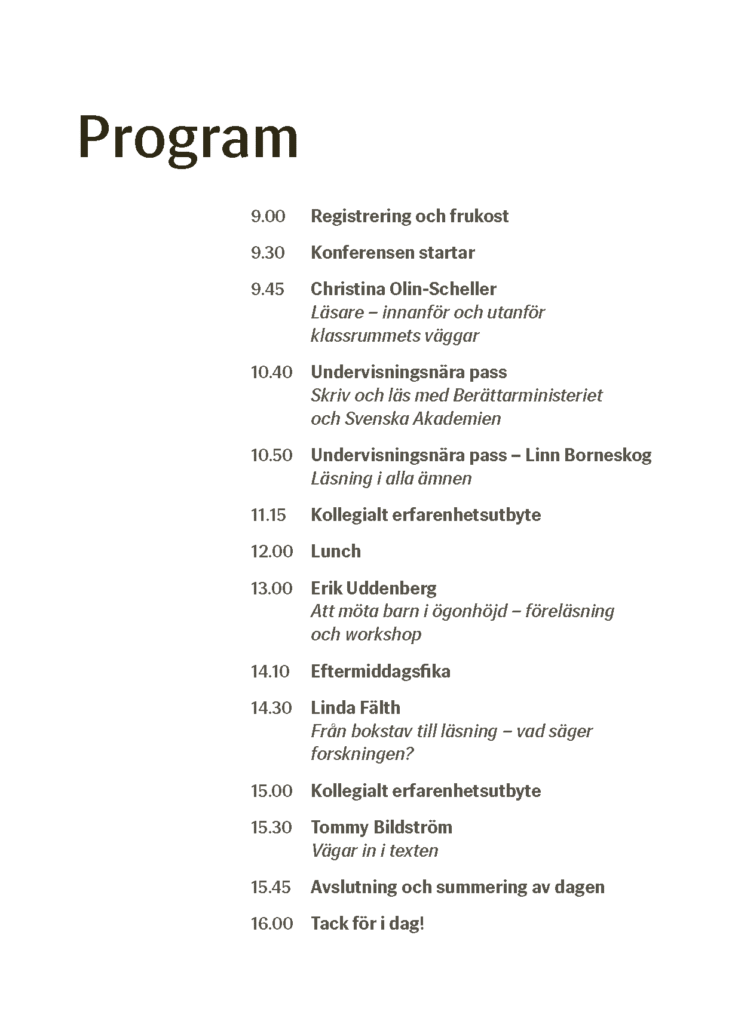
During the school year, week 44, the Berättarministeriet Education organized its annual teachers’ conference in Stockholm and Gothenburg. This year’s theme was writing and reading, and the conference was held in English.The participating lecturers possess extensive knowledge in the subject area, with expertise in pedagogy, didactics and other relevant fields.. The full-day conference offered hands-on examples with scientific basis and collegial discussion.a Exchange of experiencen. The aim is to provide conference participants with knowledge and strategies for teaching that strengthens students' reading and writing skills and, in turn, their agency, language, and knowledge development..

Writing and Reading – The Path to Agency, Language and Knowledge Development
All students, regardless of linguistic level and socio-economic background, need to be given the opportunity to develop their language skillsleague skills necessary to actively participate in school and in society. Reading and writing skills plays a central role, among other things gone of the promote studentss agent, develop their language and subject knowledge and create a common, rich and lively language. As a carrier of meaning, creativity, and knowledge, it awakens the reading curiosity, desire and understanding – factors that in turn strengthen students’ ability to navigate a complex world.
The Ministry of Education’s teachers’ conference was held over one full day and had the same program in Stockholm and Gothenburg. In connection with the conference, participants are offered the Berättarministeriet’s Education’s school program and teacher support. The conference is free of charge and is aimed at teachers and school leaders in schools with a high socio-economic index. The number of places is limited.

Linda Fälth She is a teacher and special educator at her core. She is a professor of pedagogy and deputy vice-chancellor for teacher education at the Linnaeus University. Her research mainly focuses on reading, reading development, and reading and writing difficulties.

Christina Olin-Scheller She is a professor of literature studies’ didactics and a professor of pedagogical work. She works as a teacher educator, supervisor, and research leader with a specific focus on reading and literacy instruction in the new media landscape. Her research concerns the conditions for learning, development, and identity creation in learning environments. (Photo: Andreas Lind)
Erik Uddenberg He is a trained journalist and playwright, connected to Unga Klara in Stockholm. He has also previously been artistic director of Folkteatern in Gävleborg (2015–2020). Erik works both as a playwright and a dramaturg. (Photo: Märta Thisner)

Linn Borneskog She is the head teacher of year 4–6 at Värner Rydénskolan in Rosengård in Malmö. She has worked as a teacher for 13 years and teaches Swedish and social studies. Linn has extensive experience in working with language development and in 2024 she was awarded the Berättarministeriet’s lärarpris Pennsvärdet.

Tommy Bildström He is the head librarian in Nordmaling and has a background in the industry. He thinks it is important to listen to children and young people and take the culture they are largely involved in seriously: ”it is the fantasy worlds that should be used to attract people to reading.” Tommy is a member of the reading council.

Åsa Julin has nearly 20 years of experience as a journalist, program presenter and producer at SVT and Sveriges Radio, among others, and is now active as a moderator, producer and strategic advisor in media and communication matters. Åsa is the current moderator.
